


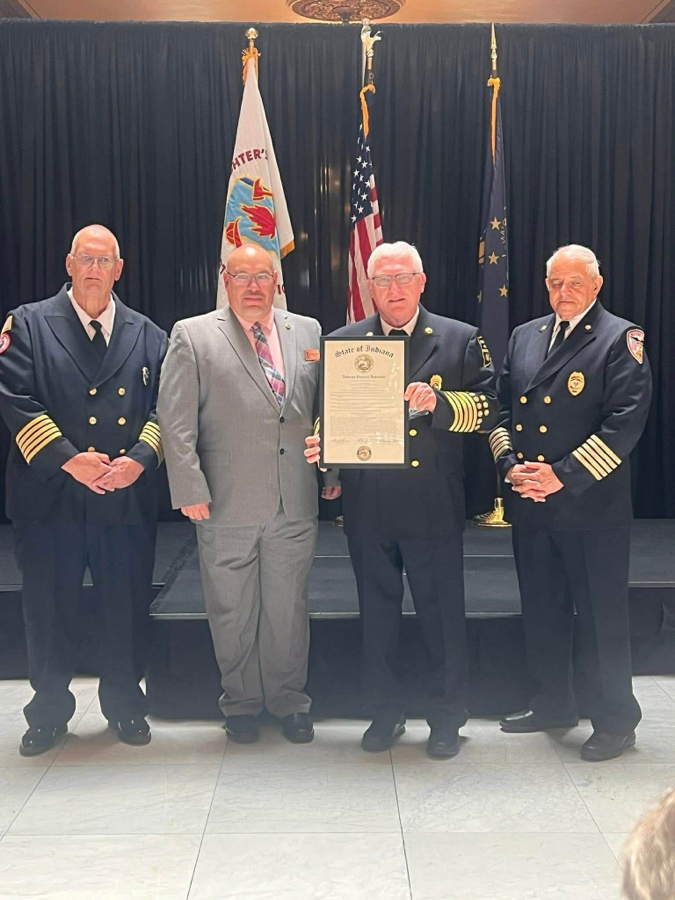
When former Everton Fire Chief Jim Reese was recently honored at the State House for 50 years of service, his first thought was simply, “Where did the time go?” For Reese, those five decades represent the evolution of local firefighting from “garden hoses” and handwritten phone lists to the modern department protecting the community today.
Reese’s journey started under the mentorship of Jim Lakes, the department’s first chief. Working for Lakes at his grocery and appliance stores starting at age 14, Reese learned the fundamentals of community service during long hours delivering appliances.
“Jim’s number one rule was to support the community, and the community will support you,” Reese recalled. It was a philosophy he took to heart when he eventually followed Lakes into the role of Chief.
In the early days, responding to a fire was a frantic, manual process centered at the store. When a call came in, Reese would have to shut down all customer interactions immediately to focus on getting the information right. In an era of rural routes instead of house numbers, getting precise directions was the first hurdle. Once the details were set, he would trip the siren and start down a handwritten call list kept by the cash register, letting each number ring twice before moving to the next.
“It felt like all the calls weren’t going out quickly enough,” Reese said. To help the trucks get moving, store staff would even run into the intersection to flag down traffic, allowing the manual-shift engines to clear the old station next to the school and head toward State Road 1.
Reese was a witness to and a leader of the technological leaps that followed. He saw the arrival of “fire phones” that rang into twenty homes simultaneously, the first pagers, and eventually, the implementation of 911. Reese actually served on the original committee that brought the 911 system to the area.
The equipment has seen a similar overhaul. When Reese joined in 1976, turnout gear consisted of rubber gloves, plastic hard hats, and “night boots” that pulled up to the mid-thigh. Trucks lacked power steering and were equipped with small 250 GPM pumps. “We had to fight all our fires with booster lines only—basically a garden hose,” Reese remembered. “But the best part was riding the tailboards of the trucks responding to an incident.”
The former Chief’s legacy is most visible in the department’s current infrastructure. He was part of a team alongside Nick Freeman, Debbie Kidd, and Ray Gulley that worked tirelessly to secure grants for the current fire station and engine. The need for a new home became undeniable when they discovered the old station was infested with termites. Reese recalls working all night on the grant application while the team prepared the presentation in Indianapolis an effort that ultimately resulted in the modern facility Everton uses today.
For Reese, the service was always a family affair. He and his father-in-law, Cliff Fledderman, frequently “talked shop” at the dinner table, and Reese’s own children grew up in the department. Seeing his family support him at the State House was the highlight of the ceremony.
“You will reach unbelievable highs and unthinkable lows,” Reese said, offering advice to the next generation of firefighters. “But most importantly, you will be part of an incredible family.”
After 50 years of managing the challenges and rewards of leadership, the former Chief remains most proud of the growth of that family the brothers and sisters in the fire service who continue the work started back in 1957.

Discover more from Whitewater Valley Voice
Subscribe to get the latest posts sent to your email.